



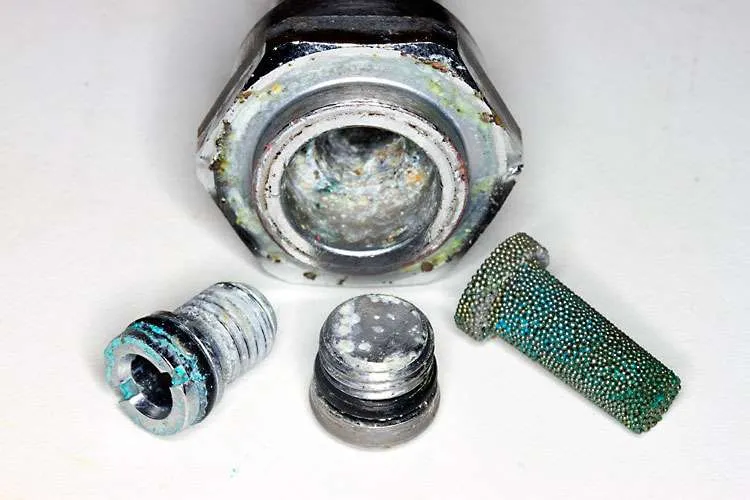
Ever wondered what that white, green and blue crusty stuff is that forms on scuba diving equipment. That crusty stuff has a name – Verdigris.
Verdigris is the green patina that forms on copper and certain copper-alloy surfaces when they are exposed to moisture and oxygen. While it is a natural corrosion product, its presence on scuba gear may indicate material degradation or the need for maintenance.
Attention to verdigris is essential to preserve equipment performance and safety.
Why verdigris forms
The formation of verdigris results from moisture, carbon dioxide, and certain ions (such as chlorides) in the environment reacting with the copper in the brass that is used to manufacture most scuba diving equipment. While manufacturers usually plate the brass in chrome to help prevent this corrosion from forming, the harsh salt water eventually pits the chrome and allows the salt water to start corroding the underlying brass even if the coating looks visually intact.
Damage to the outer chrome coating or prolonged damp storage without adequate drying can allow verdigris to develop even quicker.
Some manufacturers use more exotic materials in their equipment (like titanium) to help prevent issues caused by verdigris, however often these are only used internally, and often have separate issues.
Issues caused by verdigris
Have you ever found yourself needing to cough while underwater?
Verdigris is mildly toxic, causing irritation to breathing pathways when inhaled. Something specifically hazardous to scuba divers, particularly when growing internally to air pathways.
Verdigris can also cause multiple mechanical issues such as causing air balancing mechanisms to jam. It also causes mechanical buttons to stick, seizes inflation valves, prevent regulator breathing adjusters from turning and corrodes screw threads. Allowed to grow unchecked, verdigris can prevent parts from being disassembled and even compromise a parts integrity causing catastrophic failures.
Equipment issues can be caused even with only minor buildup; as verdigris is most often attributed as the single point cause of scuba equipment failure.
Verdigris most commonly appears on scuba equipment components such as:
- Regulator housings, particularly first stages
- Hoses and fittings
- Bolt-snaps, clasps and swivels
- Torches and camera equipment
While parts composed primarily of aluminum, stainless steel, or polymers are less susceptible, they may still be affected if copper-bearing coatings or fittings are present.
Prevention strategies
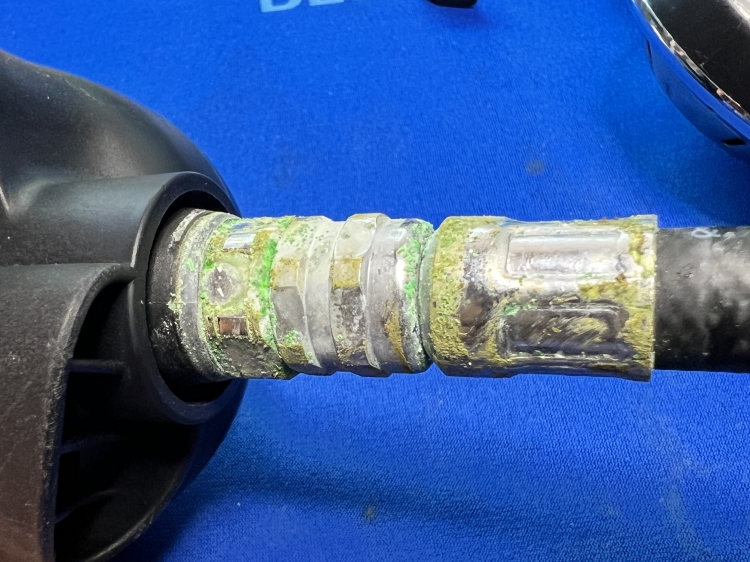
- Store equipment in a dry, well-ventilated environment; try avoiding prolonged exposure to humidity or salt air if possible.
- Thoroughly rinse and dry all metal components after diving. Allow equipment to soak in fresh clean water for a similar time as the dive if possible.
- Move hose protectors regularly to allow rinsing underneath.
- Remove DIN/Yoke adapters and rinse separately
- Apply appropriate protective coatings as recommended by the manufacturer (such as silicone grease/oil or lanolin), and re-coat as directed during maintenance cycles.
Most of all, schedule regular professional equipment servicing, to catch early corrosion signs before they compromise safety.
How to assess your equipment
- Inspect regularly: look for green or blue-green films, powdery residues, or irregular discoloration on brass or copper containing parts.
- Inspect hose fittings regularly by moving hose protectors.
- Check the functionality of moving components frequently, such as work of breath adjustments and sliding bolt-snaps.
- Remove DIN/Yoke adapters frequently for inspection
- If suspicious staining accompanies flaky metal or surface pitting, halt use and seek professional evaluation.
When to seek professional service
- Verdigris covers a large area, penetrates protective coatings, or shows signs of underlying metal damage.
- The affected component is critical to gas flow or buoyancy control, or its function or structural integrity is in doubt.
- Standard rinsing/cleaning does not mitigate the corrosion, or recurrence occurs despite preventive measures.
– Safety note –
Never attempt to disassemble, modify or bypass safety-critical components. If there is any doubt about the integrity of regulator bodies, valves, or pressure-rated parts, cease use and consult a certified technician or the original equipment manufacturer.